
Maryland Resident Lookup: Record Coverage
| Record | What It Confirms | Where | Access |
|---|---|---|---|
| Property assessment | Owner of record, property and mailing address, deed reference | Maryland Department of Assessments and Taxation (SDAT) | Address, account, or map search; no owner-name or ZIP search |
| Deed and land record | Grantor, grantee, transfer date, legal description | Maryland's address-to-deed route or circuit court clerk | County index start dates vary; older indexes and clerk copies may be needed |
| Court case index | Case number and type, court, party names, dates, disposition | Maryland Judiciary Case Search | Public index; 600-result cap; protected matters omitted |
| Estate index | Decedent, status, filing dates, representative, attorney, alias | EstateSearch | Statewide from 1998; older county coverage varies; full files are local |
| Voter registration | Own registration status, districts, and polling place | State Board self-lookup | Self-check requires voter details; a separate list request has a sworn-use rule |
| Vital event | Birth, death, marriage, or divorce index or verification | Maryland Department of Health (MDH), local health office, court, or State Archives | Index, verification, and certified copy have different access rules |
| Business filing | Entity status, resident agent, principal office, trade name, filing roles | Business Express | Most documents after August 2001 are online; other images can be requested for a fee |
A resident lookup here works record by record. It does not draw from one statewide roll. Ask first what you want to know. Is it a parcel owner, a case party, or a dated event?
Check the direct custodian, then confirm with a second one. Owner, voter, case party, licensee, and personal representative are different roles in the records. So keep your dates straight. Answer one question at a time.
Note: A property record names an owner and mailing address, not everyone who lives there.
Maryland Case Search by Name
Case Search covers District Court traffic, criminal, and civil cases, plus Circuit Court civil and criminal matters and appellate filings. Names are exact by default. A trailing % matches partial names, but you cannot use it at the start or middle of a name. Narrow results by court, case type, and dates. For a company, try Person Search with the business name in the last-name field.
| Search field | Type | Use and limits |
|---|---|---|
| Person or Company | Mode | Required; company names may need Person Search |
| First name | Text | Optional; exact or partial with trailing % |
| Last name | Text | Usually required; partial needs a first character before % |
| Court | Dropdown | Circuit, District, or appellate court |
| Case type | Dropdown | Options vary by search mode |
| Filing date range | Dates | Narrow a query below the 600-result cap |
| Party or attorney | Mode and name | Search related parties or attorneys |
| CAPTCHA and buttons | Challenge | Complete, search, reset, or open a result |
A result can include the following fields, when the case record has them:
- Party name, city and state, case number, and related names
- Date of birth when included, trial date, and court
- Charges, disposition, event history, and judgments or liens
Event codes mark what actually happened in a case. Filings, appearances, bonds, releases, hearings, and dispositions each carry their own code, and the Judiciary glossary explains them. Coverage has limits worth knowing. District Court criminal entries begin in late 1991, civil entries in 1989, and some older history is simply unavailable. Appellate terms and Circuit Court start dates vary. Broad queries return up to 600 records.
Maryland Court Records Offline
A blank result does not mean no case exists. The file may be older, unconverted, nonpublic, or just unavailable electronically. Local clerks hold those files. The Judiciary's Case Search FAQ describes the written or in-person request route. Phone requests are not accepted.
When you write, give the county, the court, the party name, and the year. Include a case number if you have one. Add the document you want. Ask about inspection on site. Also ask about certified or uncertified copies. A name hit alone never proves an allegation as a finding.
Errors happen. For a wrong docket entry, write to the court where the record began. Include the case number and any documents supporting the correction.
Maryland Custody Record Searches
The Maryland Department of Public Safety and Correctional Services locator covers people currently in qualifying state custody. That includes Division of Correction and Patuxent placements. It is not a statewide arrest, booking, release, or county-jail history. A pretrial detainee can sit in a local detention facility. That person may never appear in this state search. Use the Maryland incarcerated individual locator. Read its name fields and scope before drawing any conclusion from a result.
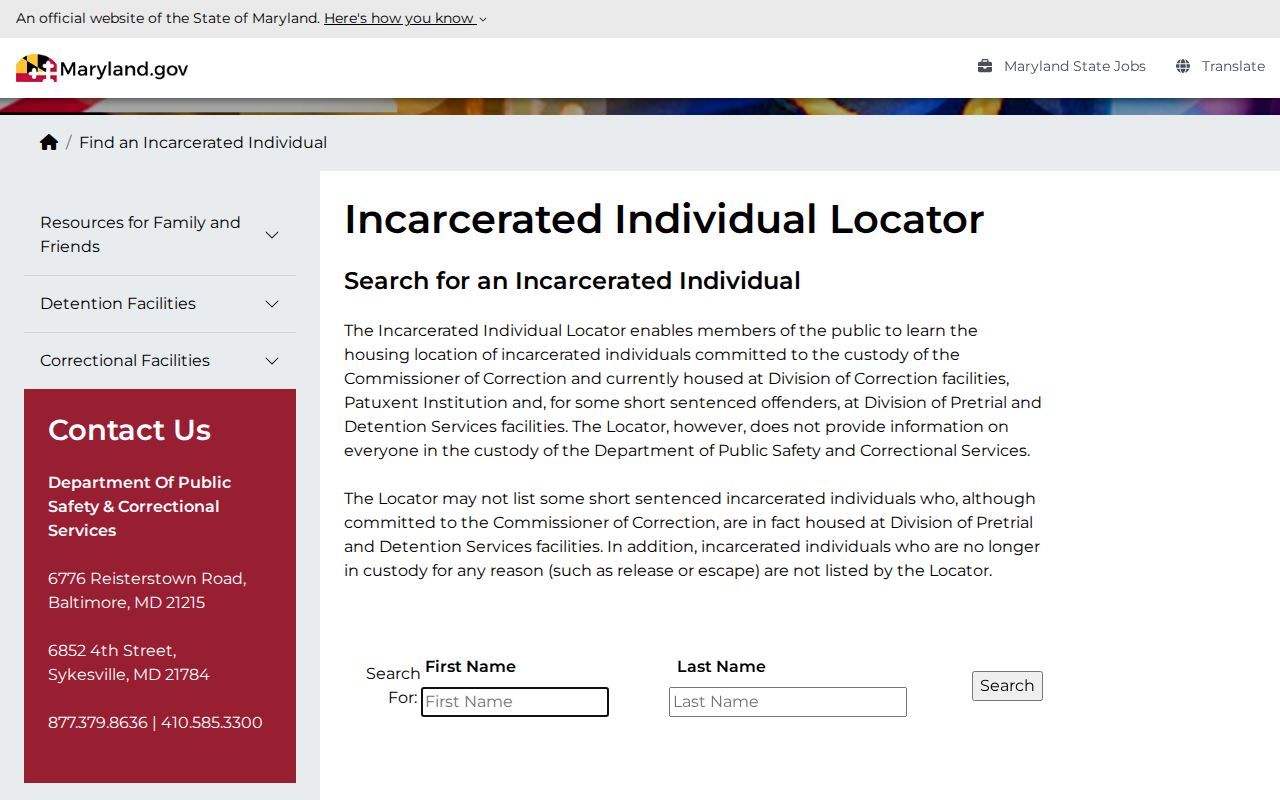
One result covers only one system. A hit reflects a qualifying current state placement, nothing more. It does not trace a full case history, and it cannot show where a person lives after release.
Federal custody is entirely separate. The Federal Bureau of Prisons inmate locator accepts a register number or a name, with optional filters for race, age, and sex. Federal records begin in 1982. Release dates can change.
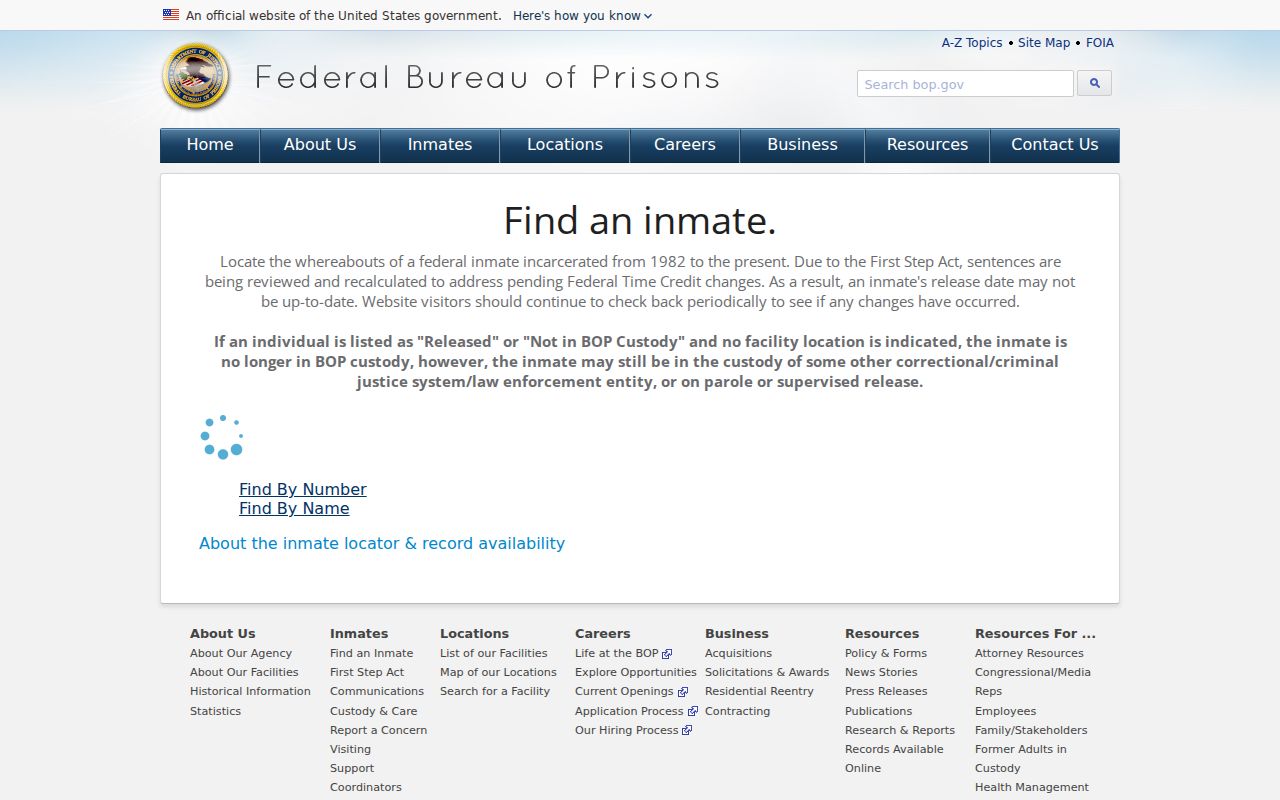
A federal result covers federal custody only. A person who has been released may still appear in a state or local system. No single locator settles every Maryland court or jail question.
Maryland Registry Record Limits
The Maryland registry search is its own public-record tool, with name and location options. It displays registry fields as reported to the agency. Treat the data carefully. It is time-sensitive and self-reported. A match does not prove identity beyond the record itself. A missing ZIP or empty map area does not mean no covered record exists. The Maryland registry search explains its filters and the limits attached to the published data.
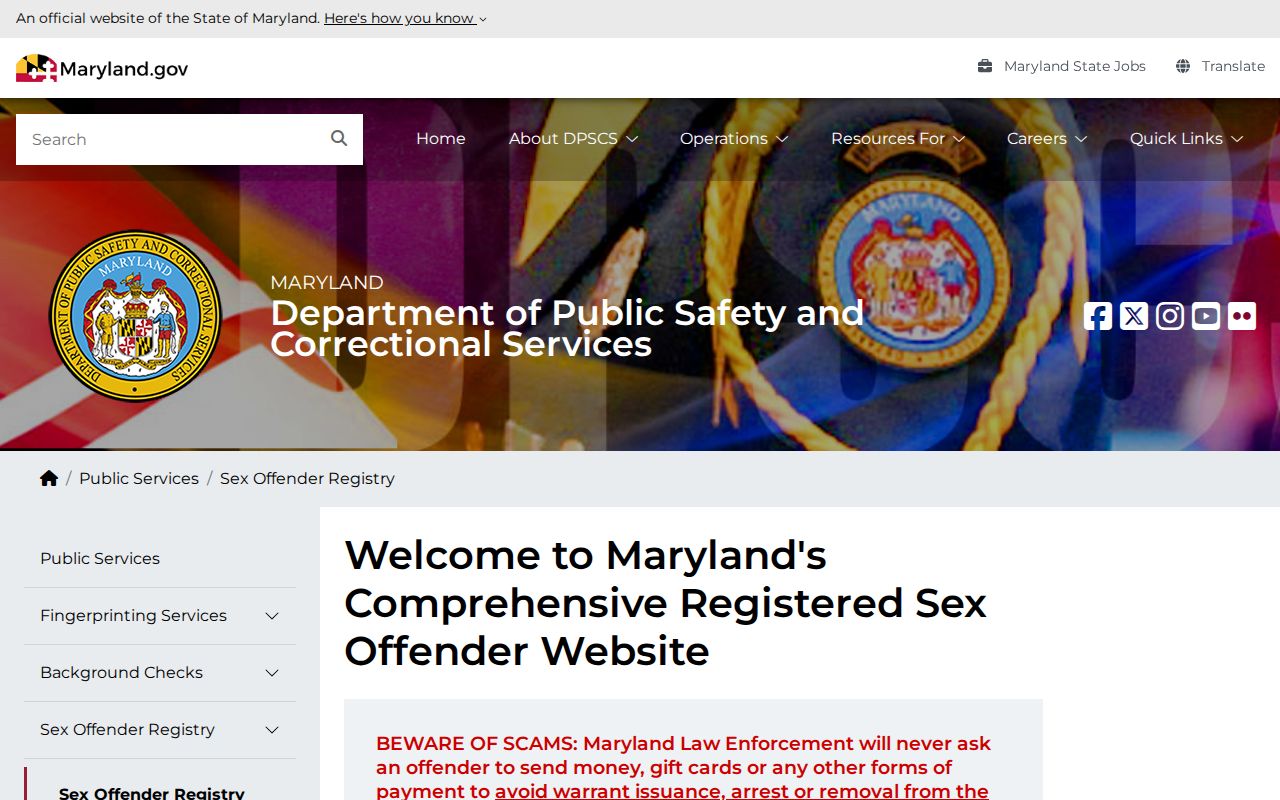
Read the agency's warnings before relying on any result. Never contact, threaten, harass, or harm anyone based on a listing; confirm identity and case status with the responsible public office.
Maryland Voter Lookup Fields
The Maryland State Board of Elections lookup serves one voter at a time. A person can review their own registration, request a duplicate card, check a polling place and districts, and view ballot status. They can also see a sample ballot. The form asks for several registered details together. A name alone will not work. The Maryland Voter Lookup form shows exactly which fields that self-check requires:
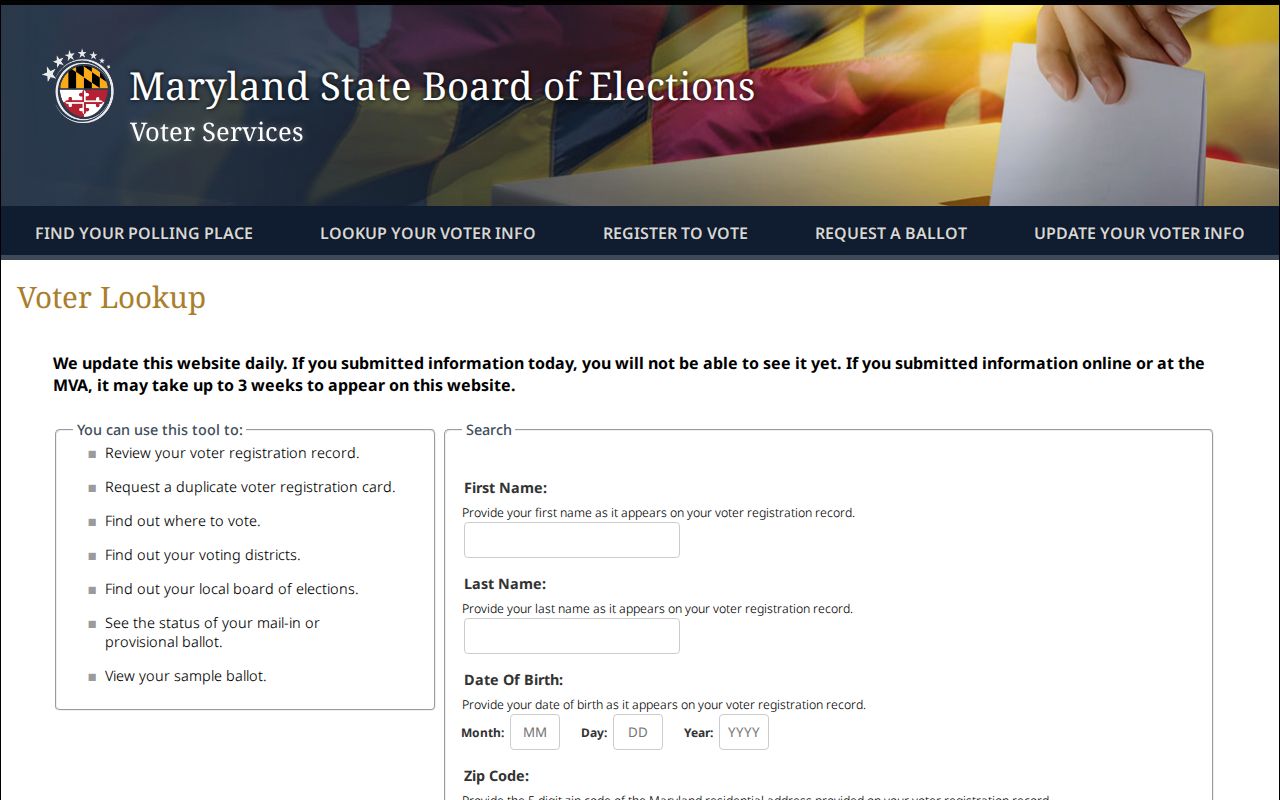
These fields tie a voter record to one registered address. They support a personal check, not a public browse-by-street tool.
| Field | Required | Format or purpose |
|---|---|---|
| First name | Yes | Use the spelling on the registration |
| Last name | Yes | Letters, hyphens, and spaces; use the registered form |
| Date of birth | Yes | Month, day, and year fields |
| ZIP code | Yes | Five digits for the address on the voter record |
| Street number | Yes | Numbers and common address marks; a fractional indicator is not needed |
| Middle initial | No | Use it if it matches the registration spelling |
The lookup refreshes daily. Still, new online updates or Maryland Motor Vehicle Administration (MVA) information can take up to three weeks to appear. A polling place or district never proves current occupancy.
Maryland Voter Search Limits
A blank result does not mean a person is absent from Maryland or unregistered. Check the spelling used at registration, a former ZIP code, or a former name. Allow for update delays. The local board can also help.
Election Law §§3-505 and 3-506 govern public inspection and voter lists. A Maryland registered voter must apply in writing. The applicant must swear the list will be used only for electoral purposes. It may never be used for commercial solicitation. The State Board prices a statewide list at $125. One county, district, or municipality costs $75. Delivery comes by FTP, mailed flash drive, or pickup. It arrives within 10 working days after payment and application. Apply before the advanced registration deadline or after election day.
Protected addresses stay withheld. Public data never shows Social Security or MVA numbers, full birth dates, or ballot choices. A list may not be used to investigate how a person voted. That ban covers any particular election. See the voter-list request page for the current oath and form.
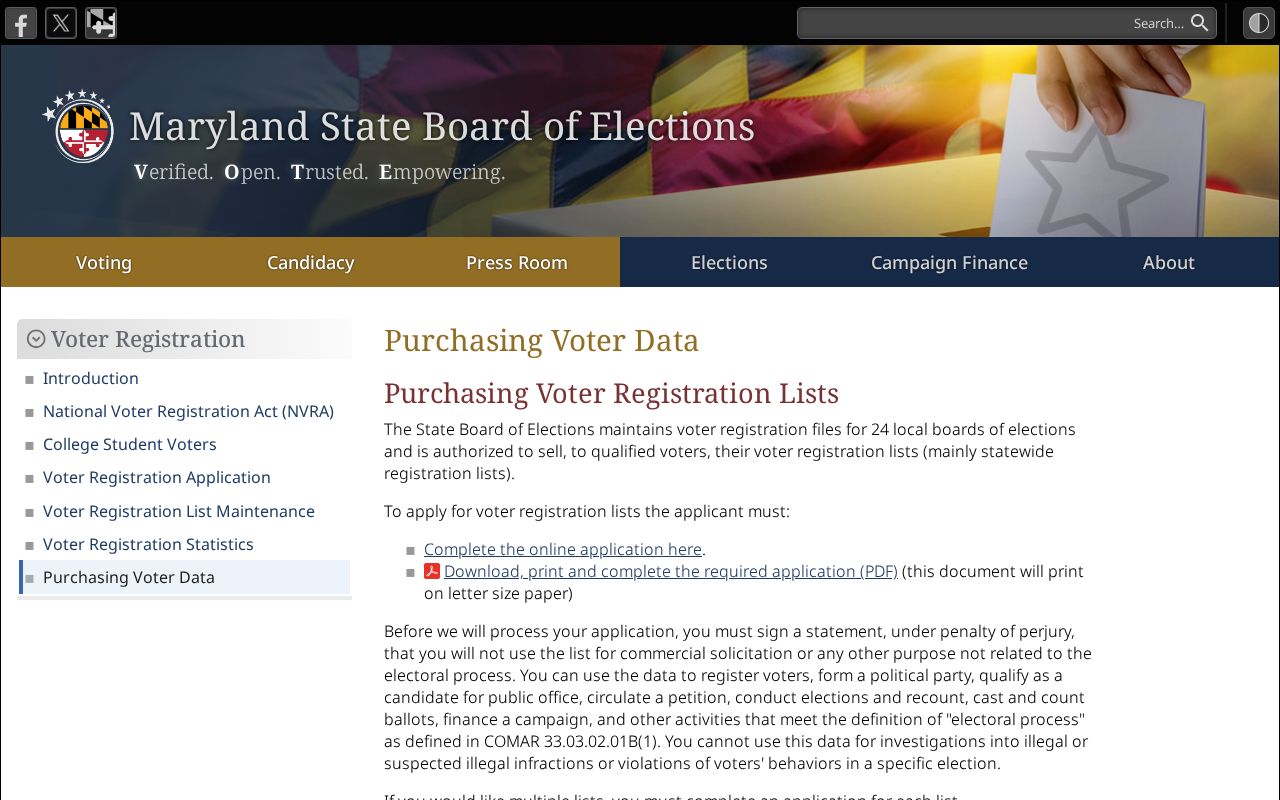
Use that form only through the Board's stated eligibility and electoral-purpose process. It is not an address-by-address residents directory.
Note: A polling place or district result locates an election record, not necessarily a current household.
Maryland Vital Records Have Separate Gates
Maryland marriage certificates split by date. Before 2007, the circuit court clerk in the ceremony county holds them. Later certificates come from the Department of Health instead. The marriage-record page explains current access and ordering.
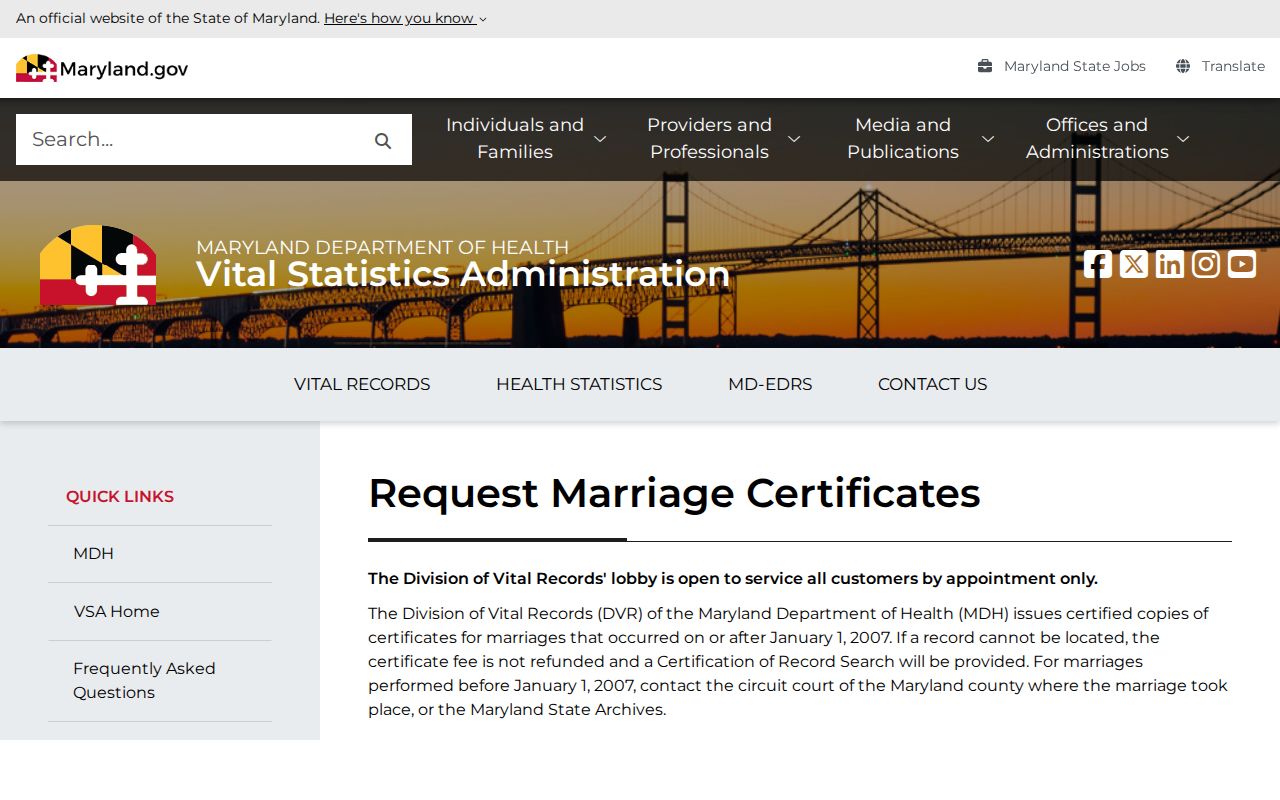
Who may order a marriage copy is narrow. The spouse qualifies. A notarized representative with the spouse's permission also qualifies. An attorney for the spouse may order as well. Each copy costs $12 by mail with ID and a self-addressed envelope. VitalChek handles online orders for an added fee. Confirm the current submission route before sending anything.
Birth records under 100 years stay restricted unless the named person has died. Eligible applicants include the person, a parent, a surviving spouse, a guardian, or an authorized representative. The MDH birth-certificate page covers ordering, identification, and delayed-birth guidance. An Archives index may sit open while the certificate itself stays closed. Death-copy eligibility turns on relationship, legal need, or tangible interest. Archives treats deaths under 10 years as recent and older ones as unrestricted. The MDH death-certificate page spells out who qualifies and how to apply.
Divorces from 1992 onward take a different path. The MDH VRC-81 divorce verification form confirms date, place, and type. It does not confirm the decree itself. The $12 form requires ID, and the circuit court keeps the actual decree. An obituary or index entry is only a lead toward the real record.
Note: An index entry can guide a search, but it does not grant eligibility.
Maryland EstateSearch and Other Person Records
EstateSearch earns its keep when a person may have died. It also helps when an inheritance is in play. Its statewide index reaches back to 1998, though older county entries run uneven. A result may list the decedent, estate number and status. It may also show key dates. Personal representative, attorney, and any alias may appear too. The local Register of Wills keeps the full estate file.
For business ties, Maryland Business Express searches by name, Department ID, or employer identification number. Filings show status, principal office, resident agent, trade-name filer, and amendments. Most documents after August 2001 sit online; missing images can be requested for a fee. Remember that a filer is not automatically an owner or resident.
Yearbooks and old city directories give a former classmate a dated lead worth chasing. License records vary by board in what fields they show.
Verify a Maryland Resident Across Records
Use dated records to answer one question at a time. Owner, grantee, case party, voter, licensee, and representative are distinct roles.
- Note the name, county or Baltimore City, year, and spelling variants.
- Search Case Search exactly, then partially; narrow by court and date, and save number and disposition.
- For inheritance, check EstateSearch. For a known address, use SDAT and follow its deed reference in MDLandRec.
- Use voter self-lookup for that voter. Check a vital index; request a copy only if eligible.
- Compare two custodians and dates. If an index stops, ask the clerk for a written or in-person route.
- Docket
- A court case record and dated events.
- Index vs. image
- A search entry versus a page image; one may exist without the other.
- Grantor / grantee
- The party who transfers property and the party who receives it in a deed.
- Disposition
- The recorded case result or status.
- Certified copy
- A copy attested as true by its custodian.
A same-name hit is only a lead. Compare city, age, party role, address, or a relative before concluding anything. A mailing address is not always a residence, either. To look up a resident with confidence, match the name to another dated source in the residents directory trail.
Maryland Public Records Request Steps
Start any Maryland records request by naming the record creator and current custodian. Counties, Baltimore City, and municipalities each use different offices. Local boards hold voter originals. Clerks keep court files. Vital records shift among several custodians. MDH, local health offices, courts, and Archives each hold them depending on date and event.
The Maryland Public Information Act, General Provisions §§4-101 through 4-601, governs existing agency records subject to exemptions. Name the custodian. Describe the record narrowly. State a preferred format. Asking for a fee estimate or waiver up front avoids surprises. The law does not require an agency to create a new record. It also does not force an answer to a general question. Any denial must state its exemption and appeal route. The Ombudsman can mediate disputes.
For a court file, write or visit the local clerk. Bring the name, county, court, year, case number, and the document sought.
Maryland Record Privacy Limits
Privacy rules shape what any Maryland residents directory can show. The federal Driver's Privacy Protection Act shields MVA names, addresses, birth dates, license numbers, Social Security numbers, photos, and similar identifiers. Access requires consent or a permitted use. Juvenile, adoption, sealed, shielded, and expunged records carry their own limits. Some vital records do too. Safe at Home helps too. It gives people fleeing domestic violence, human trafficking, sexual assault, stalking, or harassment a substitute address with mail forwarding. Agencies must honor it absent a legal exception or approved waiver. Election rules further protect participants' home addresses.
Maryland's Online Data Privacy Act took effect October 1, 2025. Known as MODPA, it grants rights to know, correct, delete, and limit processing. It also adds opt-outs covering sale, sharing, targeted ads, and profiling by covered businesses, with exceptions. Public information sits outside its personal-data definition. So the law does not erase a government deed, court docket, or Archives index. You might still use one in a resident lookup. MVA privacy rules govern a separate data source entirely.
Maryland's privacy policy and official program links explain covered-business rights and Safe at Home enrollment. To fix an index error, write to the record's custodian with the number and proof.
Personal use. Use Maryland records for lawful personal research and verify a match with the custodian. Do not use a result to stalk, harass, threaten, or intimidate anyone.