
Finding Previous Residents in Maryland
Maryland splits its records by county and by record type. Pick the right jurisdiction first. Baltimore City stands apart from Baltimore County. SDAT's real-property search links a current parcel to a recent deed, while Circuit Court Clerks keep the recorded instruments themselves. Directories and released census years place a person at an address, and Sanborn maps and permits add building context. Each source covers different dates and different questions.
| Source | Years It Covers | Where Held | What It Shows |
|---|---|---|---|
| MDLandRec land records | County cutoffs differ; older Historical or Retired scans may reach back to early records | Maryland State Archives and Circuit Court Clerks | Recorded transfers, liens, plats, legal descriptions |
| Baltimore City directories | BMS31: 1800-1940 with gaps; other runs vary | Maryland State Archives and Baltimore City Archives, Pratt, partners | Dated names, addresses, occupations, businesses |
| Annapolis directories | 1896-97, 1910, 1924, 1934, 1939; phone runs include 1909, 1932, 1936-37, 1947-48 | Archives Special Collections, SC 2140, and local collections | Household and business checkpoints |
| Federal census | Decennial; public after the 72-year release rule | National Archives and library databases | Household members on the census count date |
| Sanborn maps and local permits | By town, edition, and local retention schedule | Library of Congress, Maryland State Archives, libraries, and local permit offices | Building form, use, and dated work, not a complete occupant list |
Treat these as checkpoints, not a statewide occupant list. Baltimore holds the deepest directory runs. Elsewhere, the Maryland State Archives directory guide and a local library catalogue carry the load. A gap never proves a house stood empty, so record each name, source, date, and role, whether deed party or directory entry.
Maryland Index Cutoffs
Maryland's electronic deed search starts at county-specific cutoffs, not one statewide year. Baltimore City is separate. Older names may sit in Historical or Retired scans that cannot be searched as text. A blank result can mean the date predates the cutoff. Or the clerk indexed another spelling. Check the county cutoff. Switch indexes before you call the search complete.
The Maryland MDLandRec portal displays the county selector. It also shows the routes into a name search or a known book-and-page reference.
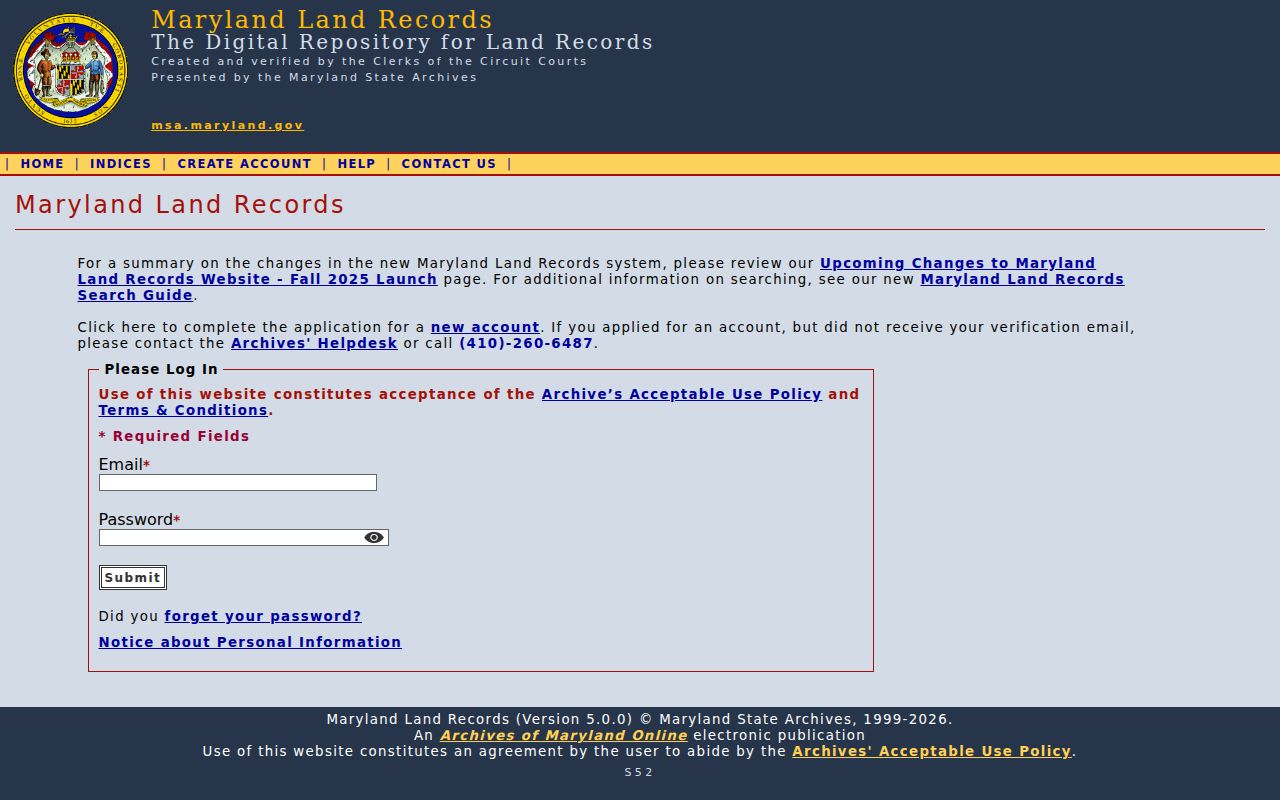
The county choice matters. Select Baltimore City apart from Baltimore County. Then check the date line before treating any search as complete.
MDLandRec's current release supports Begins With, Contains, Fuzzy, and Soundex name searches. Historical and Retired scans must be browsed by hand. A known clerk, book, and page opens through Jump to New Volume, and the portal posts the current account and page access terms.
| MDLandRec field | Type | Required | Maryland search note |
|---|---|---|---|
| Select New County | Dropdown | Yes for a county search | Choose the specific county or Baltimore City. |
| Last or corporation name | Text with modifier | No | Exact, begins, ends, contains, fuzzy, or Soundex. |
| First, middle, suffix, legal capacity | Text with modifier | No | Search a spelling or role from a deed. |
| Ownership and party type | Radio buttons | No | Individual or corporation; grantor or grantee. |
| Instrument, remarks, date range | Text and date controls | No | Set an instrument term or deed date. |
| Book and page | Text or number pair | With Jump | Use a deed reference from SDAT or an earlier index. |
County-by-county date ranges limit the electronic index. Note: Because electronic coverage varies by county, the Historical and Retired scans are the essential next step for older Maryland deed research.
Trace Maryland Deeds Backward
Start with the parcel. Follow each recorded transfer backward. SDAT shows the current owner name and a deed reference. In MDLandRec, search the grantee on that instrument, inspect the deed, then search its grantor in an earlier period. Keep the legal description at every step. A street number can change, while a lot, plat, or boundary description shows whether two deeds cover the same land.
- Save the county, account or property account number (PAN), premises address, owner, legal description, sale date, and SDAT deed reference.
- Open the book and page in MDLandRec. Note the instrument type, date, parties, and plat reference.
- Search the grantor as a grantee in an earlier period; compare legal descriptions.
- Repeat backward. For an estate or company, keep the legal capacity and branch to its record.
- At the county cutoff, switch to Historical or Retired scans, the clerk terminal, or a copy request.
- Grantor / grantee
- The grantor transfers an interest; the grantee receives it. A deed can list several parties.
- Chain of title
- Recorded transfers and related instruments tied to one parcel.
- Legal description
- The deed's lot, plat, or boundary calls, which can identify land after an address changes.
- Criss-cross directory
- A street- or address-based directory for finding an occupant without starting from a name.
- Legal capacity
- The role in which a party signs or appears, such as trustee or personal representative.
A deed chain is a research aid. It is not a title opinion. Several events can branch the chain. A trust, estate, foreclosure, subdivision, boundary change, or deed among several parties each adds a fork. If a deed names a company, check Maryland Business Express; for an estate, use EstateSearch. Save the instrument number and image page, and seek qualified help for any legal conclusion.
Maryland Address Records Start at SDAT
Maryland's public Real Property Data Search finds an address or parcel, not an owner by name. Choose the county first. Then try the street without its direction or suffix. SDAT suggests omitting the number, truncating a name with a wildcard, or using an account/PAN or map reference. Results can show an owner, premises and mailing addresses, sale details, and a deed reference. A mailing address receives assessment notices. It does not prove where a person lives.
| SDAT search field | Use | Maryland format note |
|---|---|---|
| County | Required jurisdiction choice | Separate Baltimore City from Baltimore County. |
| Street number and street name | Address search | Try the name without direction or suffix; a truncated name may use an asterisk. |
| Account or PAN | Known property-account search | Format varies by county; Baltimore City uses ward, section, block, and lot. |
| District, map, and parcel | Map-reference search | Enter the parts shown for the county's parcel. |
The public search does not find property by owner, ZIP code, town, neighborhood, or subdivision. Some sales tools include area fields. Still, none is a general owner search. Tax bills and payment history belong to county or Baltimore City tax offices, not SDAT. Local assessment offices keep public terminals. Staff can help identify an account when an online search fails.
Note: Keep the premises address and mailing address in separate fields. They answer different property questions.
Past Maryland Residents in Directories
A deed proves ownership. A directory can tie a name to a street for one edition year. Baltimore's Matchett, Woods, and Polk books carry address sections. Annapolis has dated city and telephone directories. The Baltimore City Archives and Maryland State Archives list their holdings, while libraries may keep print, microfilm, newspapers, and yearbooks. The collections are described on the Maryland city directory page. Check each title page and abbreviation key.
Pair an address with a household by tracking each edition, spelling, district, and year.
- Use an edition near the event date. Copy the name, relative notation, occupation, address, and printed owner or resident mark.
- If the name is unknown, search the street section and compare nearby editions for moves or number changes.
- Compare the entry with a released census. Directories are often annual; a census records a household on one date.
- Use age, birthplace, occupation, and nearby names to sort people with the same name. A missing entry does not prove vacancy.
Only census years released under the 72-year rule can be used. A directory may show a person between censuses. The census may list more household members on a single day. Mark each entry. Note whether it names an owner, occupant, or business. Also note any mailing contact.
House-history use. Keep this work to property history, family research, genealogy, or another lawful personal purpose. A public listing is not permission to track or harass a living person, and restricted or confidential records should stay protected.
Maryland Previous Residents and Sanborn Maps
Sanborn maps can date a building, not its occupants. They may show its footprint, stories, materials, outbuildings, and street setting. Editions depend on place and year. The Library of Congress Sanborn collection supports place and year searches; older local editions may be at the Maryland State Archives or a library.
Baltimore City's E-Permits portal includes property, permit, inspection, application, and contractor lookups. Other Maryland jurisdictions use local systems. A permit or SDAT improvement year can date work, but neither proves who lived in the building. Compare it with a deed, directory, or map.
Maryland Address Records Across Time
Old house numbers rarely match modern ones. Maryland offers no single statewide renumbering schedule. Bridge a change with dated street directories, old maps, street-number files, plats, and the deed description. Where a source gives both forms, search each. Subdivision or reassessment can change an account too. So keep the legal description and plat attached to every number.
Baltimore City and Baltimore County are separate worlds. Each keeps its own land records, assessment identifiers, courts, and directory collections. Annapolis and other towns may hold municipal records beside county deeds. So note the county or independent city apart from the postal city. Then follow each record to its custodian.
Not every gap is a portal cutoff. Some come from fire. A 1704 State House blaze destroyed most Anne Arundel County records. It spared only the newest court and land records. An 1882 fire at the Prince Frederick courthouse, plus a later temporary-office fire, caused further losses. For those periods, pair surviving deeds with church, tax, directory, newspaper, or probate sources.
Note: A new street number or parcel account is a reason to compare maps and legal descriptions, not to assume the property changed hands.
Maryland Archives for Past Residents
A stalled online index is not the end. Circuit Court Clerks keep other channels open. A counter or public terminal gives access to older land indexes, and the clerk accepts written copy requests as well. Ask the clerk or Archives for a certified copy. Name the county, the parties, the date, and the book and page if known, plus the instrument sought. A Maryland Public Information Act request under Md. General Provisions §§4-101 through 4-601 can reach a fuller public records series; the Attorney General's PIA resources explain the process and its exemptions.
Focused archive request. Give the office the county, record type, date range, sources already checked, and exact question. Ask for the series, index terms, and retention details.
Library shelves hide missing directory years. The Enoch Pratt's Maryland Department holds local history, genealogy, newspapers, and maps, and the Maryland public library directory points to county systems nearby. Ask staff whether an item is indexed, browseable, microfilmed, digitized, or boxed, then note its collection and edition.
Newspapers, obituaries, cemeteries, and probate extend a dated occupant's trail, and Maryland's EstateSearch covers estates statewide from 1998. Some counties reach back further. The complete file stays with the local Register of Wills. An obituary is only a lead. Verify it with the custodian.