
Maryland's City Directory Holdings
No single statewide run covers Maryland. Baltimore City is unusually rich. The exact editions for Annapolis and other towns depend on the repository and its local catalog. The coverage table gathers publisher, year span, shelf, and access route in one place. A listed range can still hold gaps. And a record for one city says nothing about the rest of the state.
| Collection | Years | Where Held | Access |
|---|---|---|---|
| Baltimore City miscellaneous directories, BMS31 | 1800–1940, with gaps; listed years include 1800–1838, 1842, 1858, 1867–74, 1878–81, 1891–1908, 1911–13, 1917, 1920, 1922–23, 1927–28, 1936, 1940 | Baltimore City Archives; Maryland State Archives (MSA) | Print and microfilm; many through 1923 link to digitized copies |
| Matchett's Baltimore Director | 1816, 1819, 1822–24, 1827, 1829, 1831, 1833, 1835–38, 1840–42, 1847–55, related editions | Maryland State Archives, Enoch Pratt, University of Maryland (UMD), digitized examples | Consult title page; online examples and local print holdings |
| Woods' Baltimore Directory | 1855–57, 1858–59, 1860, 1864–84, other listed editions | Maryland Archives, Pratt, UMD, digitized sources | Print or online by edition; verify the year |
| Polk's Baltimore City Directory | 1887–1930; 1936, 1937, 1940, 1942; 1955–59 microfilm and selected later print | Baltimore City Archives, Maryland State Archives, Pratt, Johns Hopkins, UMD, Library of Congress microfilm | Print, selected microfilm, and selected digitized holdings |
| Baltimore telephone directories | 1931–39 runs, plus 1942, 1955–59 and other holdings | Baltimore City Archives; Maryland State Archives; Pratt; Library of Congress | Print, microfilm, and some digitized reels; subscriber list only |
| Coleman / First Colored Professional, Clerical, Skilled and Business Directory | 1913–14 first edition; later listed community editions | Maryland State Archives, Pratt, Howard University, Morgan and partners | Free digital images through Archives of Maryland Online, plus partner holdings |
| Annapolis I Remember and city directories | 1896–97, 1909 telephone, 1910, 1924, 1932 telephone, 1934, 1936–37 telephone, 1939, 1947–48 telephone; 1887 Anne Arundel section | Maryland State Archives Special Collections, MSA SC 2140 | Request the exact item or consult the catalog before a visit |
Baltimore titles appear as early as 1752. A 1796 title follows. The BMS31 series then begins in 1800. Later phases bring Matchett, Woods, and Polk. Telephone books join them later. Each carries its own year list, and overlaps occur.
The Maryland State Archives directory-year list names publishers and repositories for Maryland titles. Check it before you travel. A Baltimore volume may wait in print, on microfilm, or online.
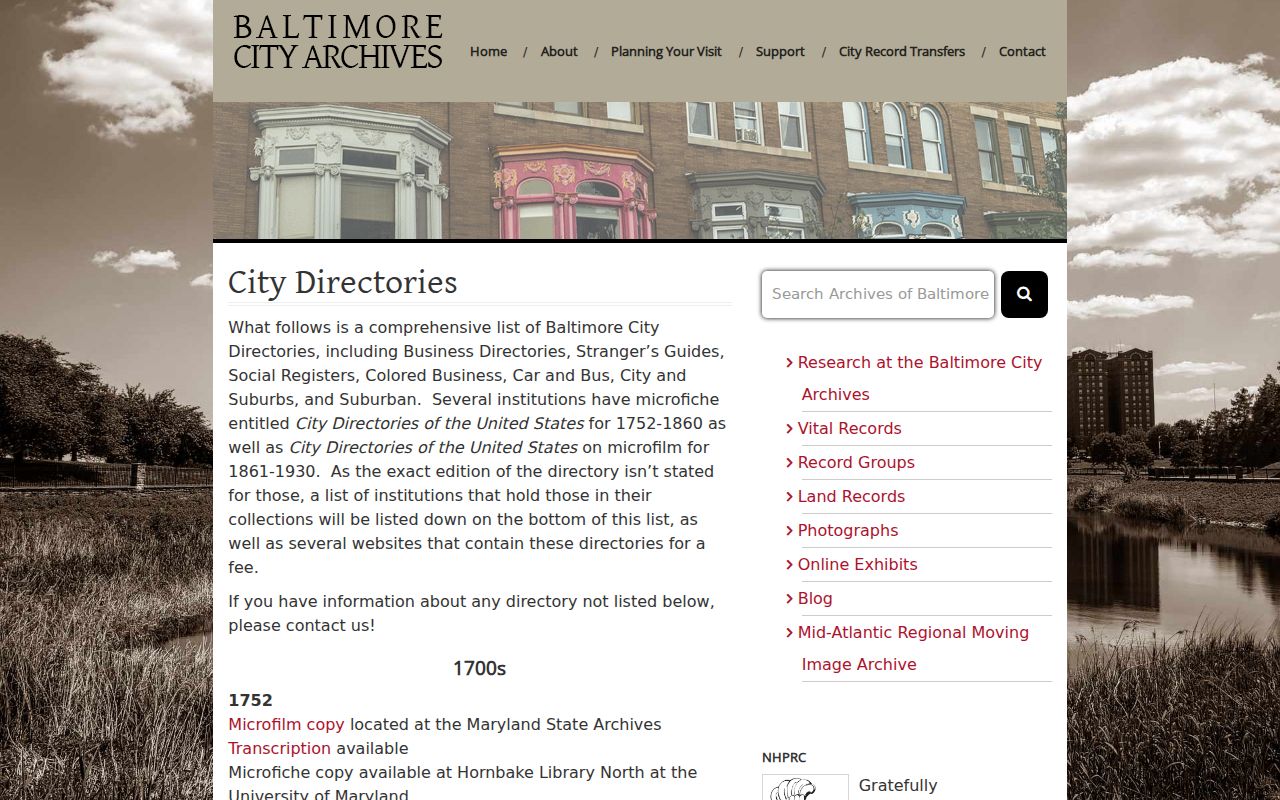
Treat the list as a finding aid. It does not promise that every year is online. A missing line may call for microfilm, a library catalog search, or a request to staff, not a broader date claim.
Digitized Maryland Directories
Each digitized directory is a specific edition. The Maryland State Archives links many Baltimore volumes through 1923 to Archive.org. Other Maryland scans sit in Archives of Maryland Online or partner collections. A hit in a catalog may be just a catalog record. OCR misreads names and street numbers too. When a page image appears, open it and read the entry yourself.
The Maryland State Archives' Coleman directory is different in kind. It lists Baltimore's African-American professional, clerical, skilled, and business community. The first edition is dated 1913–14. Later listed books and the digitized series reach Annapolis and Washington, D.C. Still, these scans skip plenty of Maryland towns and years.
Note: open the volume itself and record the title and page for each name. Anyone can then check the finding again.
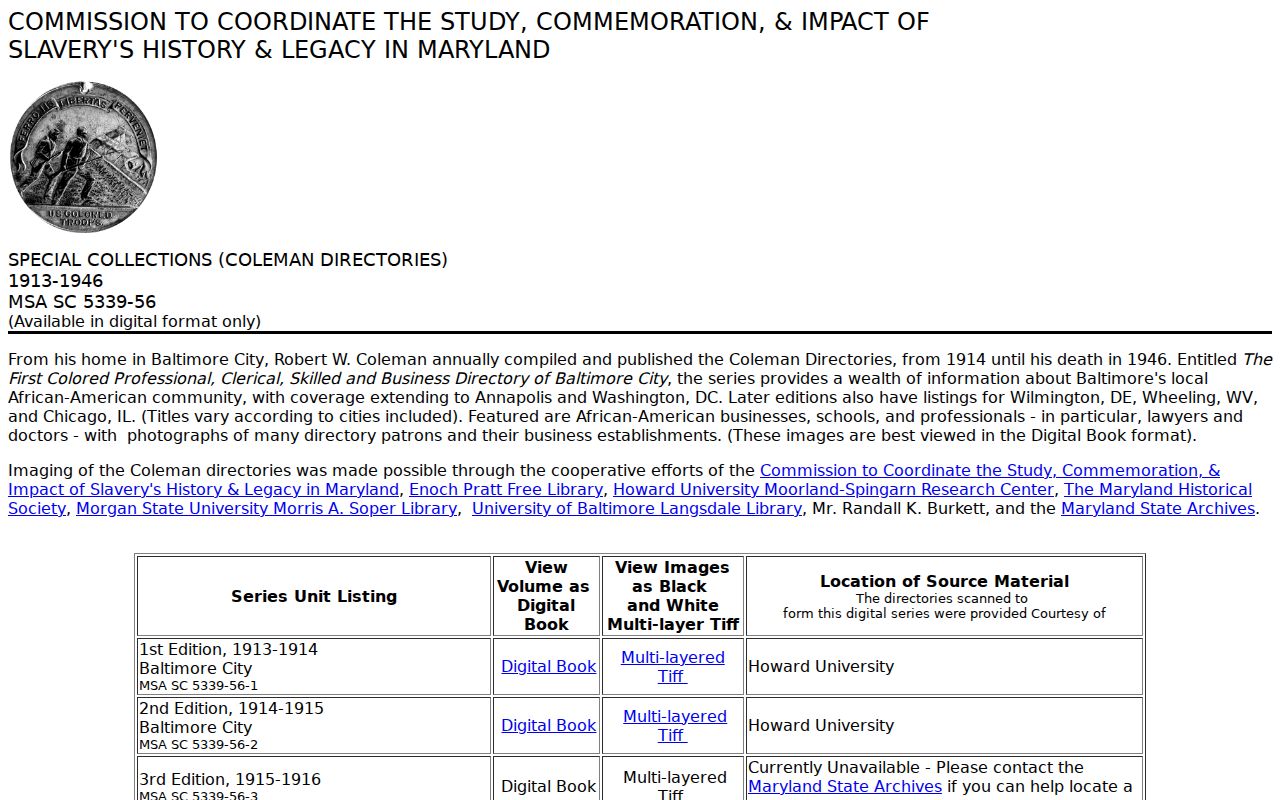
This collection gives a separate window on Baltimore names and businesses. Cite the publisher, the edition, the page, and the printed wording exactly.
Enoch Pratt's Maryland History Shelves
Enoch Pratt Free Library's Maryland Department, at the Central Library on 400 Cathedral Street in Baltimore, handles local-history and genealogy reference, Maryland materials, and maps. Call 410-396-5430. Special Collections does not circulate. Appointments are recommended, and staff can provide copies or scans.
Other Maryland libraries hold local shelves worth a call. The University of Maryland's Maryland Room and Hornbake Library keep directory microfiche and print, and Johns Hopkins directory records can be searched by collection. The Maryland Center for History and Culture finding aids describe local materials, and the Maryland State Library Resource Center's public-library directory points to county rooms, yearbooks, and microfilm.
For the department's Maryland research scope and service details, see the Enoch Pratt Maryland Department's reference page.
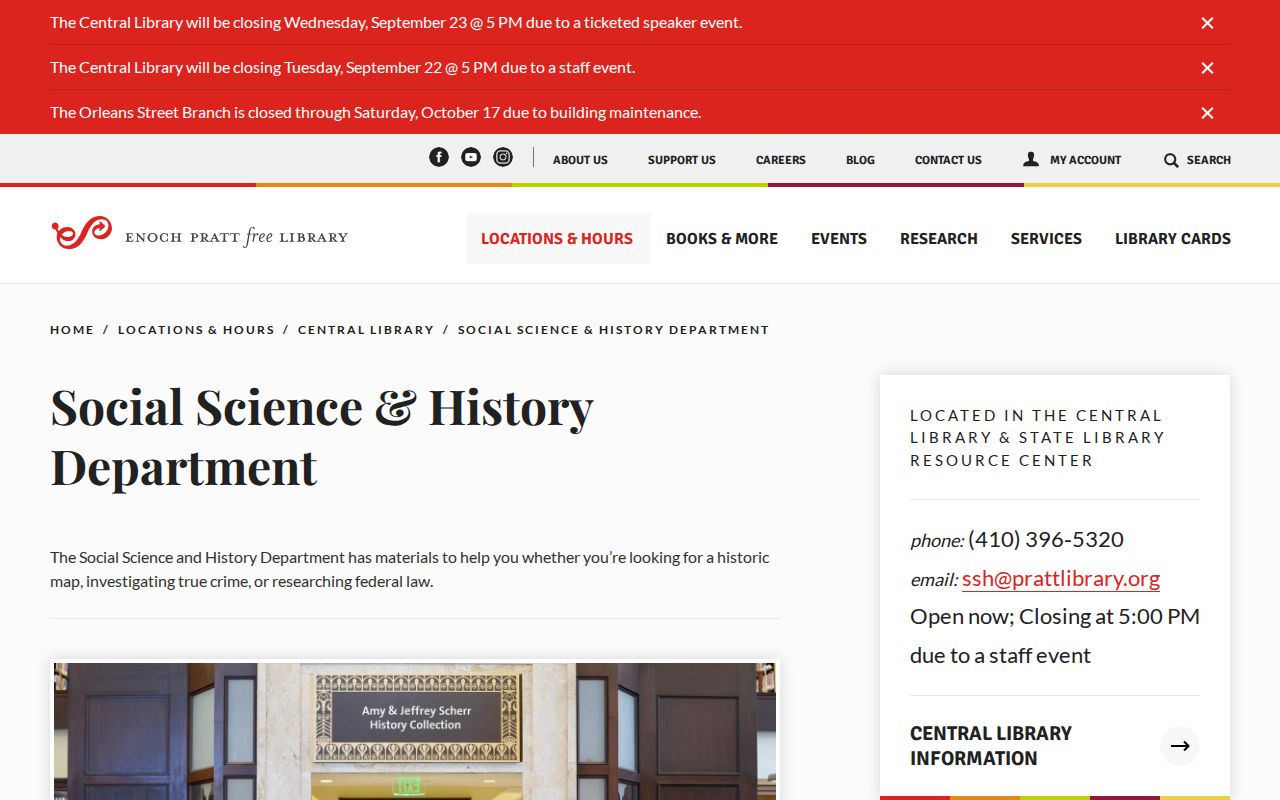
The Pratt page leads to reference help, not an online directory index. Ask the staff which edition, map, or local file fits the Maryland town and years you need.
What Maryland Directory Entries Record
Each Maryland directory entry ties a name to details collected for that edition. The listing may carry a surname with initials. A spouse often sits in parentheses. Occupations, employers, or a shop name can follow, along with the residence address. Later Maryland volumes sometimes mark owners with an "h" and renters with an "r," and a few entries note a widow or a boarder. Publishers differed, so fields and marks shift from one book to the next.
| Entry part | What to record |
|---|---|
| Name | Surname and given name or initials; preserve the spelling as printed. |
| Spouse or household note | Parenthetical spouse, widow, or boarder notation when the publisher uses it. |
| Occupation or business | The listed trade, business, employer, or shop detail, if present. |
| Address and mark | Street address plus any edition-specific “h” or “r” notation. |
| Street section | A separate street-order entry may connect an address to a listed occupant. |
- Criss-cross directory
- A later street-order section that lets a reader start from an address and find the name printed beside it.
- Householder index
- The alphabetical resident-name section used to find a person; the exact label and layout can vary by volume.
- Abbreviation key
- The publisher's legend for shortened words and symbols. Check the key before expanding any mark.
Remember what an entry actually proves. A Maryland listing places a person at an address during the collection period, nothing more. It does not confirm ownership or year-round presence, and an annual volume may reprint details reported a year earlier.
Annapolis and Maryland's Other Runs
Annapolis directories sit in the Maryland State Archives Special Collections. The catalog number is MSA SC 2140. The set spans city and telephone directories. It also holds an 1887 Anne Arundel section from a combined directory and gazetteer. Treat these as capital-area checkpoints rather than a Baltimore or statewide coverage list.
Other towns appear in the Archives Guide and local catalogs. Holdings show up for Cambridge, Cumberland, Frederick, Hagerstown, La Plata/Waldorf, Laurel, and Lexington Park/Leonardtown. Year runs vary across Maryland. Before traveling, confirm the call number or microfilm reel. Check with a county library, a Maryland room, a historical society, or the Archives.
Start with the Maryland Archives directories guide. If no scan appears, ask a local library about print or microfilm copies. A thin digital result never means the Maryland edition is lost.
County libraries in Maryland each build their own collections. Harford's Maryland Room in Bel Air is reference-only. Dorchester's Virginia Webb Maryland Room keeps yearbooks plus public microfilm at Cambridge and Hurlock. Kent County's Maryland Collection offers on-site Ancestry Library access. Database licenses differ across Maryland, so ask which services demand an in-person visit. Historical societies round things out with surname files, church collections, and cemetery transcriptions. Some also offer research help.
Tracing Maryland Households by Year
Begin near a known family event. Maryland spelling and coverage shift from edition to edition, so record every title and year you consult. Search the alphabetical name section first, then check the street-order section if the volume includes one.
- Find the person in the closest surviving edition. Copy the printed name, Maryland address, spouse or relative note, occupation or business, and marks.
- Check the street section for that address. Keep its spelling and number as printed.
- Compare the nearest earlier and later books that survive. Note changes; do not fill missing years by guesswork.
- Pair a directory year with the nearest released federal census. Directories are annual and address-focused; census schedules are decennial and household-focused.
- Resolve same-name entries with another dated source. If the town lacks a book, ask a Maryland library about phone or farm directories, yearbooks, church registers, poll books, and newspapers.
Federal census schedules for Maryland open to researchers in ten-year steps from 1900 through 1950. The 72-year rule holds them back. Each one freezes a household at a single moment. A city directory covers the in-between years. So a family that moved, remarried, or took in boarders between census days can still be tracked through the printed pages.
When a name goes missing, the cause may be simple. A move, a spelling shift, or a skipped edition explains most gaps. For anyone checking who lives at an address today, old books are the wrong tool. A current Maryland owner or address check belongs in modern property and deed records instead. For present-day details, the Maryland street directory page pulls together current street records by address.
Check the Maryland Edition Key
Read the title page and the abbreviation key before copying anything. Baltimore publishers did not use the same marks. A Polk symbol might mean one thing and a Matchett or Woods mark another. The difference can change how an entry reads. Note the title, publisher, date, and page. Also note whether you worked from print, microfilm, or a scan.
Some Maryland series have no index at all. In that case, write the Archives Search Room at 350 Rowe Boulevard, Annapolis. You can also call 410-260-6487 or email msa.helpdesk@maryland.gov. Name the county or Baltimore City, the record type, the date, and what you already checked. Ask for a series, call number, or reel to speed the reply.
Note: Save the edition key and the printed page reference with each name so another researcher can check the same mark.
A Directory Is Not a Census
Know what each record actually proves. A Maryland directory links a name to an address on a given date. A census counts one household at one decennial point. A deed records a land transfer, and nothing more, so the person named is rarely everyone who lived there.
No single source lists all Maryland residents. Holdings differ by town and by year. Some books survive in print, others only on microfilm, and OCR can bury a misspelled name deep in a scan. A blank result never proves absence, so compare dates and ask which other record series the state keeps.
Old findings still need a modern check. The Maryland resident lookup page explains how to compare a directory hit against current records. Keep the old entry labeled as historical evidence, not as a claim about a present address.